Welcome ...

D-MoZone is the place to find out what’s new with pianist/composer/educator Diane Moser. Keep an eye on this blog for updates on music, health, gigs, fundraisers, random thoughts and all things D-Mo. And please keep sending your thoughts, good wishes and comments this way—they’re always needed and always appreciated.

Monday, June 20, 2011

"Bivio" Tom and Jackie Colao's new restaurant!

 
They did it-they finally did it! Tom and Jackie have been talking about opening up a little place-and now it's a reality!
It's called Bivio which stands for "fork in the road"-and that is exactly where they are-at a fork in the road off of Main St in Little Falls, NJ. Tom told me that they had picked out the name of the restaurant several months before they found this location-synchronicity at work again!

 They designed the place themselves-and it is absolutely beautiful. They even have a sliding barn door in the back. I  felt like I was back in Italy-in a little rural village where the locals walk into town and have leisurely lunches.

For those of you who know our big band-you'll recognize Tom Colao as one of our alto saxophonists. But what many of you may not know-Tom-who we also call Chef Tomasso-is an incredible chef-and is as passionate about food as he is music. What a wonderful combination of passions!
 
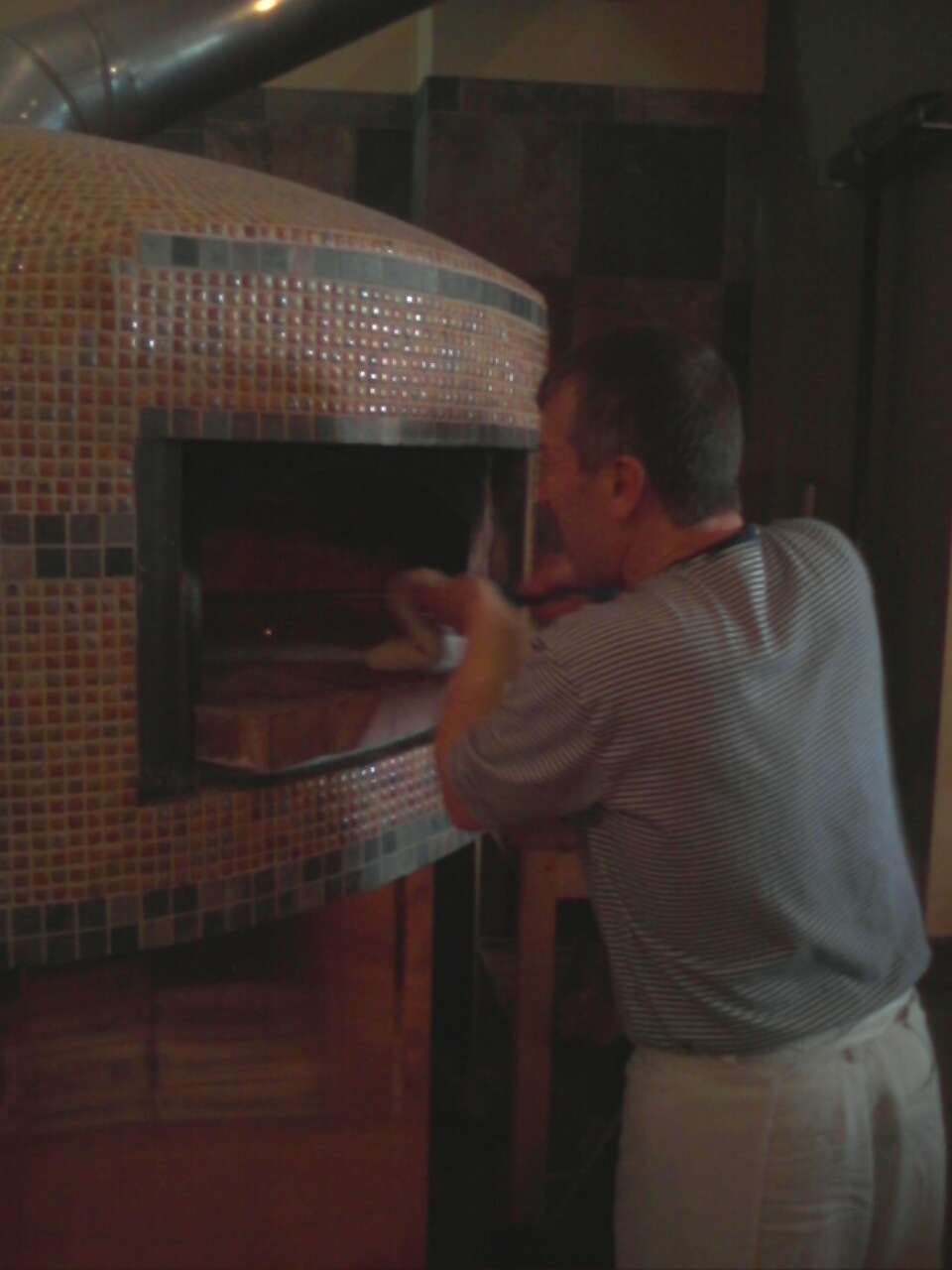
 Tom is making Neapolitan Pizza in a brick oven that was built especially for Bivio by the Italian master Nobile Atti. Tom pointed his infrared thermometer into the oven for me to see-and the temperature was well over 1,200 degrees. He throws in some wood,stokes the flames, makes the pizza,lays it in the oven and in a manner of minutes it's done!

He uses "00" flour from Naples, San Marzano tomatoes, extra virgin olive oil, fresh basil, fior di latte or bufala mozzarella and sea salt as his prime ingredients. There are 5 different kinds; Marinara, Margherita,Bianca,Porcini and Filettti. I had the Porcini-(because I love Porcini mushrooms!)-which also had San Marzano tomatoes,fior de latte mozarella, fresh basil. extra virgin olive oil and sea salt. It was wonderful! My understanding about this style of pizza is that 'it's all in the dough' and this dough was scrumptious!

They also have 3 kinds of salads...arugula,mixed greens and fresh mozzarella with roasted peppers.
Beverages range from mineral water, Italian sodas, and of course espresso and cappuccino, and there are desserts.
 Go check it out!
 They are open Tuesday-Saturday, 5PM-10PM. The phone is 973.256.0090.
Benvenuto!
 

Wednesday, June 8, 2011

Breaking Boundaries;The Art of Alex Masket on public television!

For all of you who did not see the film-you can see it on public television station NJN on June 23rd at 10PM and June 29th at 1AM. This is part of the Black Maria Film & Video Festival and there are many wonderful films that will also be shown.

You can view the trailer to Breaking Boundaries here
You can also connect on Facebook here 
This video is from our recording session and the music is from the end of the film.


It was very exciting to be a part of this project and we are all amazed at the reception it has received not to mention the thousands of folks who are now seeing Alex's work.

Film maker Dennis Connors filmed Alex at work for over 18 months as well as interviews with his family and many others. I came on board as composer, and brought my quintet along for the ride in late August of 2009, and we finished everything in 10 days! Phew, what a ride that was-thoroughly enjoyable, charged with creativity.

Here's a description of the film from Dennis Connors youtube site:
This film by Dennis Connors is a short documentary that chronicles the story of Alex Masket, a unique and extraordinary artist who has created a deep and varied body of work despite a disability that inhibits what most might consider to be 'normal' human interaction. Containing interviews with art experts and a community of supporters, Breaking Boundaries documents the kinetic energy and wholly individualistic style of a young artist, and brings into sharp focus the notion of what artistic communication and the creative impulse is all about.

Enjoy!
Diane

Sunday, June 5, 2011

Longer Gleevec use extends GIST patient survival - CNBC

Longer Gleevec use extends GIST patient survival - CNBC

There were press releases galore from my google alert on Gleevec delivered to my inbox today. Novartis has completed a study that compares patients who took the drug for 1 year versus 3 years.....and this is the big news......the overall survival rate was also higher with 92 percent of those who got three years of Gleevec therapy still alive after five years compared with 81.7 percent for those who took the Novartis pill for one year.

After five years the numbers go down a little bit........In the 400-patient study, five-year recurrence-free survival was seen in 65.6 percent of those who received Gleevec for three years. That compared with 48 percent in the one-year group.

But hey-as my oncologist says-there are more drugs out there that I can take if my gene mutation/cancer cells become resistant to Gleevec.

The World Science Festival was in NYC this past week, and there was a discussion about cancer and sequencing genomes. From the NYTimes.....

Why try to sequence cancer genomes? Dr. Besser asked.

Dr. Lander said that cancer was caused by mutations and that it was “nuts” to think the disease could ever be cured without understanding what had gone wrong genetically. But the first step was to sequence the normal human genome; then, cancer genomes could be tackled. Cracking the normal genome cost a few billion dollars, but since then, he said, the cost of sequencing had dropped to $10,000 or less per genome, and so it made sense to apply the technology to cancer. Samples are needed from many patients with each type of cancer, he said. Sequencing a cancer from one person will reveal many mutations, but not all of them will be involved with the disease.

Genetic findings have also led to some very focused treatments for cancer: drugs like Herceptin, for women with a certain type of breast cancer, and Gleevec, which is used for some blood cancers and gastrointestinal stromal tumors with specific mutations.

I sent a sample of my tumor tissue for research and to figure out my "personal" gene mutation to Dr Chris Corless of the Oregon Science and Health University. He then puts that with all of the other samples that are being sent from around the world so that they can create a data base and study the gene mutations.

I am still on 400 mgs of Gleevec-which I take every night. I used to have most all of the side effects listed, but now it's just down to edema, muscle cramping (which can be very painful at times) and the occasional upset stomach. Chemo fog is still an issue, early morning and late at night. I take it before I go to bed so that the bulk of the metabolizing happens when I sleep, but that's also why early morning is difficult. if I took it during the day I would really be out of it. Lately I have found that drinking green tea really fires up my neuro transmitters-specifically "Yogi Green Tea Energy" which is a combination of green tea, spearmint, lemongrass and komucha. I combine it with organic black tea for a very delicious ice tea!

Overall, this is good news I'll take the 92% any day! I'm now starting year 3 as of 2 months ago, so who knows, maybe in another year they will have figured out why some people become resistant-that would be a blessing.

Friday, May 6, 2011

Chemo Fog

Hallelujah! Today a friend sent me the link to the NYTimes story and finally..what I and so many other cancer survivors have been telling the world...yes Virginia, there is Chemo Fog!
From the article......
The findings, based on a study of 92 cancer patients at Fred Hutchinson Cancer Research Center in Seattle, suggest that the cognitive losses that seem to follow many cancer treatments are far more pronounced and longer-lasting than commonly believed.

You got that right! And ditto on how the doctors of said cancer survivors like to dismiss chemo brain as "normal aging or the fatigue of illness." I tried to tell my doc that just 1 month after my surgery, then 2 months, then 3 months, and on and on for probably at least a year...then I gave up. I even brought in the books I had found, the articles I had read and printed out-he wouldn't hear of it.

I wrote about Chemo Brain on this blog-over a year ago-3/14/10 to be exact. As I re- read that post, I will say, my brain has come alive and is much further along than one year ago. And the coming alive part is interesting to "watch"-and I mean "watch" as in the Buddhist teachings-when we watch our minds and the thoughts that develop. Even today I notice that there was a change in my memory, it's catching up, especially short term.  Just the slightest change toward the positive in my brain function makes all the difference in my daily life. I feel more connected and a part of the flow.

The fog does lift-in layers-peeling away a little at a time. And there are a multitude of things that can help; exercise, meditation, being in nature, learning to do something you've never done before, eating properly and probably most important-sleep-restful sleep.

So kudos to the Fred Hutchinson Cancer Research Center in Seattle, and thank you for validating
our experiences.


And speaking of sleep.....time for dreamland...............

Monday, January 10, 2011

Diane Moser's Composers Big Band Celebrates their 14th Anniversary!

Yes-it's true-we are coming together to perform and reconnect with each other and with all of you!
Diane Moser's Composers Big Band
Celebrating their 14th Anniversary!
special guests: Vocalist Marcelino Feliciano, composer Russ Vines and baritone saxophonist/tuba player Howard Johnson
Wednesday January 26th, 2011
8PM-11PM

$15 cover
Trumpets Jazz Club
6 Depot Square
Montclair, NJ 07042

http://www.trumpetsjazz.com/main.html
trumpets@verizon.net

We are truly excited about this upcoming performance! We haven't performed since out appearance on the Lake George Jazz Weekend in Sept 2009. After that appearance, I put the band on hiatus so that I could take some time to heal and rest and adjust to the Gleevec amongst many other issues.


Expect us to pull out some of our favorites-and we'll have a few new tunes in the second set!

The photo above was taken by Andrzej Pilarczyk at our performance at the Lake George Jazz Weekend. Andrzej is a wonderful photographer who lives in the area and a dedicated artist. His photos appear in Nippertown and AlbanyJazz.com http://www.albanyjazz.com/topfive/2010-pictures.htm
as well as area newspapers.

UNMC researchers find key in cancer's spread

We're getting closer all the time.......
share

Friday, December 24, 2010

The Rockefeller University » Newswire

The Rockefeller University » Newswire

Just saw this on the newsletter that I subscribe to from the Life Raft Group-the organization that helps people with GIST and funds scientists and doctors for research. I was just telling a friend last night that even though I am NED (no evidence of disease)-there's a very strong possibility that those little nasty cells will overcome Gleevec-the drug I take-and begin to multiply. With this new discovery-scientists have pin pointed the protein in the GIST cancer cell that is the culprit-which means now they can develop a new drug that will target and eradicate that protein if Gleevec fails.
I have to say-this is what I've been praying for because I was never satisfied with the idea that it was only the KIT protein-I knew there had to be another one. Thank you Rockefeller University!
It is by far-the BEST Christmas present ever!


Posted: December 22, 2010

Scientists identify protein that drives survival of gastrointestinal tumors

For patients with gastrointestinal stromal tumors, or GISTs, the blockbuster
cancer drug Gleevec has been a reason to hope. Since the drug’s
introduction, survival rates have climbed dramatically and recurrence has
fallen by two-thirds. But there’s a downside: over time, many patients
develop resistance to the drug. Now, scientists at Rockefeller University
and Memorial Sloan-Kettering Cancer Center have identified a molecule that
acts as a survival factor for gastrointestinal tumors, a finding that may
lead to next-generation therapies that can pick up where Gleevec leaves off.

Gleevec was initially approved for fighting chronic myelogenous leukemia and
it targets the BCR-ABL fusion protein that causes that rare blood disease.
But Gleevec also inhibits the activated KIT receptor tyrosine kinase.
Scientists have known that mutations in the gene that codes for KIT are
responsible for development of GISTs, as well as other cancers such as
melanomas, which makes Gleevec a potent treatment for GISTs.

Ping Chi, a postdoctoral fellow in C. David Allis’ Laboratory of Chromatin
Biology and Epigenetics at Rockefeller and a clinical fellow at MSKCC, and
in collaboration with Yu Chen in Charles Sawyers’ group at MSKCC, searched
for GIST-specific genes to obtain better insight on the molecular events in
GIST development. She focused on a group of cells in the gastrointestinal
tract called interstitial cells of Cajal, or ICCs. GISTs arise from two
specific populations of ICCs, myenteric and intramuscular; it’s been known
that KIT is highly expressed in these two types of ICCs, and these cells
have been implicated as the cells that spur GIST formation.

By analyzing patient tumor samples stored at MSKCC, Chi and colleagues found
that a protein called ETV1 is expressed in all GISTs at significantly
greater levels than in any other type of tumor. Using RNA interference, in
which small RNAs are deployed to prevent gene expression, Chi and her
colleagues blocked ETV1 in GIST cell lines. The result was a decrease in
cell division and an increase in cell death, findings that indicated that
GISTs require ETV1 for growth and survival.

“We’ve shown that ETV1 is just as important as KIT in the development of
gastrointestinal stromal tumors,” says Chi. The findings have far-reaching
implications, she says.

“About five percent of GISTs are KIT negative by immunohistochemistry,” Chi
says. “Because all GISTs express ETV1, we now have a very good biomarker for
diagnosing GIST.”

Chi and her colleagues were also interested in determining if ETV1 is
required for normal growth of ICCs. They looked at the gastrointestinal
tracts of genetically modified mice lacking the gene for ETV1 and observed
significant loss of only myenteric and intramuscular ICCs, providing
evidence of ETV1’s role as a survival factor for the ICC-GISTs lineage.

The discovery by Chi and her colleagues also means that scientists now have
a new therapeutic target. In addition to the risk of developing resistance
to Gleevec, the drug must be given continuously because interrupting Gleevec
treatment can cause GISTs to rapidly regrow.

“Now that we know ETV1’s importance in GIST formation, we need to determine
how the ETV1-driven oncogenic transcriptome is regulated,” Chi says. “This
opens possibilities for stopping GIST development when targeting of KIT
fails.”

“This work represents a remarkable collaborative effort from both sides of
York Avenue wherein our combined strengths in signaling, mouse modeling,
transcriptional regulation and chromatin biology came together to tackle
complex mechanisms of cancer pathogenesis,” says Allis, who is Joy and Jack
Fishman Professor. “In addition to the gain-of-function KIT mutation, our
results clearly show that cellular context, likely determined by
transcription factor networks and chromatin landscape, also plays critical
roles in oncogenesis.”